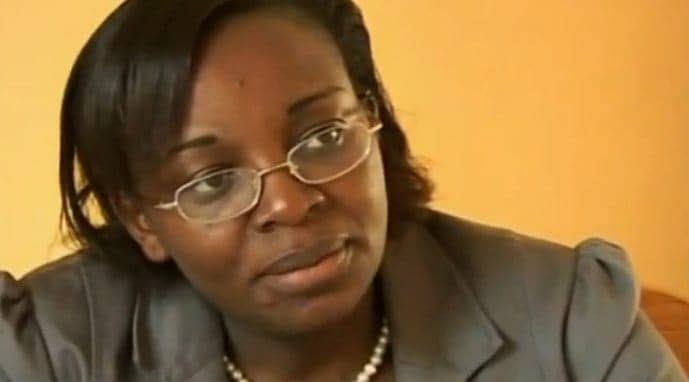
September 22, 2010 Victoire Ingabire Umuhoza spoke to Women's International News Gathering Service about the "the 'Pucinella' secret that many knew but pretended not to know" in July 2010, a month before the Aug. 26 leak of the U.N. report confirmed it. – Ann Garrison Listen to the interview: by Victoire Ingabire Umuhoza 
Victoire Ingabire Umuhoza was widely considered the leading opposition candidate in this year's presidential election, likely to win had the election been fair, but instead of being free to run, she was jailed briefly and is still not permitted to leave Kigali. The U.N. report on human rights abuse, including genocide, in the Democratic Republic of Congo has been explosive in the international community, but it simply confirms what has long been a "Pucinella" secret that many knew but pretended not to know. So many atrocities were committed, some during broad daylight, in both Rwanda and Congo, during this time that they could not be concealed forever. What happened in the Democratic Republic of Congo, the subject of the report by the U.N. High Commissioner for Human Rights (UNHCHR), was just a continuation of a pattern of atrocities that Kagame's Rwandan Patriotic Front (RPF) committed after seizing power in Rwanda, encouraged by the silence and complacency of the international community. In October 1994, a U.S. consultant hired by the United Nations High Commissioner for Refugees (UNHCR), Mr. Robert Gersony, accused the new RPF regime of having killed at least 30,000 Hutus in Rwanda since coming to power. As soon as the report was released, the regime in Kigali threatened to terminate the operations of the United Nations Assistance Mission for Rwanda (UNAMIR) if the report was validated. The U.N. then succumbed to the combined pressures of Kigali and its international lobbies and demanded that the UNHCHR put the Gersony Report under embargo while promising a counter investigation .A joint committee composed of representatives of UNAMIR and the Rwandan Ministry of the Interior handed in a flimsy report after a one day visit to Rwamagana. Special Representative of the U.N. Secretary General (UNSRSG) Shaharyar Khan refused thereafter to confirm the existence of the Gersony Report to the UNHCR. The report has simply disappeared from the archives of the United Nations, according to a communication made to defense counsel at the International Criminal Tribunal on Rwanda (ICTR). In October 1994, in the wake of the controversy around the Gersony Report, the Irishwoman Karen Kenny, whom the United Nations High Commissioner for Human Rights had appointed to head the U.N.'s Human Rights Field Operation in Rwanda (HRFOR), resigned. She said that in four months without a car, without a budget and, most importantly, without observers to be deployed, she had simply served as an alibi. This should have been an eye opener at the time, but the international press failed to pick up the story. On April 22, 1995, under the eyes of Australian and Zambian peacekeepers from UNAMIR, the Rwandan Patriotic Army massacred displaced Hutu people in Kibeho. The U.N. did nothing to make sure that the mastermind of these massacres be brought to court and punished. Instead, they simply asked the Rwandan government to follow up on the matter. Now to the core period of the U.N. Mapping Report on Human Rights Abuse in the Democratic Republic of Congo (DRC), 1993-2003. Once again the evidence has been available, in this case since 1996, but not shared with the world: In 1997, the special rapporteur of the U.N. commission in charge of human rights in the DRC, Chilean Roberto Garreton, released a chilling report on crimes committed by the Rwandan Patriotic Army against the Hutu refugees there. The Kigali regime immediately launched an intense effort to suppress the report and block a U.N. mission requested by President Laurent Kabila that was aimed at confirming the results of the U.N.'s Garreton Mission. The Garreton Mission had to give up. Moreover, many NGOs, human rights organizations and survivors gave very detailed accounts of atrocities that were committed. I simply hope that this time around, the U.N. will not again succumb to pressure and blackmail. The report should be released without alteration from the leaked version, and the U.N. should feel duty bound to make sure that a judicial mechanism is put in place to charge and try those responsible for the atrocities. If they do not, it will be another defeat for U.N. efforts to end impunity in Rwanda and the Democratic Republic of Congo. Victoire Ingabire Umuhoza is the leader of Rwanda's FDU/UDF-Inkingi Coalition of Parties and would have been its presidential candidate in this year's August 2009 election if she had been allowed to register her party instead of being arrested for "genocide ideology," Rwanda's statutory law against disagreeing with the official history of massacres known as the Rwanda Genocide of 1994. Related Posts | 
Comments
Post a Comment