
Paul Rusesabagina: another tribunal for Rwanda needed

http://therisingcontinent.wordpress.com/2013/01/12/paul-rusesabagina-another-tribunal-for-rwanda-needed/

Paul Rusesabagina: another tribunal for Rwanda needed
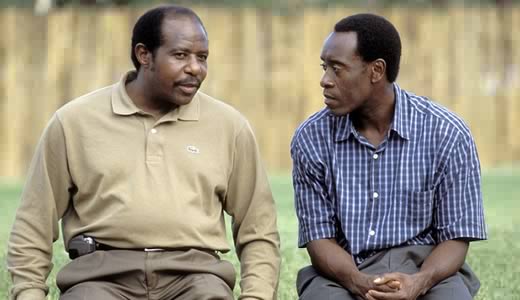
Paul Rusesabagina and Don Cheadle
In a long interview given to Daniel Kovalik and published on the Counterpunch website, Paul Rusesabagna, the Rwandan famously portrayed in the movie Hotel Rwanda by Don Cheadle, touches on a range of varied and critically important issues. He talks about 1)  criminal charges against him from the Rwandan government, 2) Rwanda civil war and genocide from 1990 to 1994, 3) massacres of Kibeho of 8,500 Hutu internally displaced in 1995, 4) bigger number of Hutu than of Tutsi who died during the Rwandan war, 5)6 millions of Congolese dead further to wars of invasion by Rwanda and other countries including Uganda, 6) UN Mapping report published on October 1st, 2010, 7) rebel group M23, 8) the U.S. role, and 8) forced sterilization of Hutu men in Rwanda.
The following is only an extract where he highlights the importance of revisiting the justice which was provided to Rwandans through the International Tribunal Court for Rwanda.
DK:  I read somewhere that you think there needs to be a new truth tribunal in Rwanda.  And, why is this, what was wrong with the first international criminal tribunal on Rwanda?  What were the shortcomings there? 
PR:  This is the problem.  In 1990, the RPF, consisting mostly of Tutsis living in exile, invaded Rwanda from Uganda.   So, when they invaded Rwanda, there was a civil war for 4 years.  In that civil war, that army, those rebels, we called them rebels at that time, were killing each and every person, every Hutu on their way.   People fled their homes.  They were occupying slowly.   And, by 1993, early 1994, before the genocide, we had about 1.2 million displaced people who were surrounding Kigali the capital city, having to bathe in town, going to sleep in the open air in camps, dying every day, hungry.  So, in 1994, these rebels, who had already signed a peace accord with the government, killed the President.   That is a fact which almost everyone knows.  So, when they killed him, the genocide broke out.  Now, we were in a civil war where civilians were being killed by both sides.  The civil war never stopped.  The genocide happened within a civil war.   Both sides killed, and now, afterwards, in July 1994, when the period of the genocide ended, after 3 months, 90 days, the Tutsi rebels took power.   They took power in blood from both sides.  And, the international community gathered the United Nations, and they decided to put up a tribunal for Rwanda.   That tribunal was supposed to try and convict Rwandans who killed Rwandans for a period of time from January 1 through December 31 of that year [1994].   From January 1 through December 31 of that year, I saw myself with my own eyes, this [RPF] army tying people with their hands behind their backs and beating their chests, breaking it, throwing them into containers, burning their bodies, and spraying their ashes into the national game preserve.  I am a witness to this.  But, because the Hutus lost the war, they are the only ones being tried and convicted.   So, the international tribunal, the international criminal court for Rwanda, is a court for the losers.  But, both have been killing civilians.  They say that the Hutus committed the genocide, but the Tutsis also committed war crimes, crimes against humanity.
To read the full interview, please click here.

Comments

Popular posts from this blog

[RwandaLibre] Rwanda : 19 ans après les massacres de Kibeho restent toujours impunis

  http://www.fdu-rwanda.com/ Rwanda : 19 ans après les massacres de Kibeho restent toujours impunis avril 22, 2014     Ce 22 avril 2014 est un triste anniversaire. Souvenons-nous, en effet, c'est à cette date que plus de 8'000 réfugiés dans le camp de Kibeho furent tués à l'arme lourde et aux lance-roquettes des soldats du Front Patriotique Rwandais. Des dizaines de milliers de rescapés du camp qui ont tenté ensuite de s'échapper ont été froidement abattus sur leur chemin de retour, les uns, jetés dans des fosses communes, d'autres, jonchés tout le long des routes, d'autres enfin, tout simplement disparus, sans la moindre trace.   Le camp de réfugiés de Kibeho abritait près de 200000 personnes. Que l'on se rappelle, c'est peu avant le 17 avril 1995 que, sous le prétexte fallacieux de démantèlement de prétendus arsenaux d'armes, six bataillons de l'armée du FPR (2000 hommes) et de la...

[AfricaRealities.com] Rwanda court hears case to block third presidential term

  Wednesday's supreme court case was quickly adjourned after the lawyer for the Democratic Green Party failed to appear. One party official told Reuters lawyers had been fearful about taking on the case.  The court panel of nine judges led by Chief Justice Sam Rugege adjourned and set the next hearing for July 29. http://mobile.reuters.com/article/idUSKCN0PI11X20150708?irpc=932 Email Facebook Twitter By Clement Uwiringiyimana KIGALI (Reuters) - Rwanda's main opposition party opened a case in the Supreme Court on Wednesday seeking to prevent constitutional change that would allow President Paul Kagame to run for a third term seven-year in office. The debate about term limits and challenges to veteran leaders has flared in several places in Africa. The United States and other Western nations have been pressing African leaders to stick to constitutional rules on presidential terms. Wednesday's supreme court case was quickly adjourned...

[AfricaWatch] Rwanda 2014: 24 years after the Ugandan invasion

  http://sfbayview.com/2014/rwanda-2014-24-years-after-the-ugandan-invasion/#.U1cA6yfqdSQ.facebook Rwanda 2014: 24 years after the Ugandan invasion April 17, 2014 4 by  Ann Garrison KPFA Evening News, broadcast April 13, 2014 Claude Gatebuke survived the mass killing in Rwanda and founded the African Great Lakes Action Network (AGLAN) to promote truth and reconciliation in Rwanda and the rest of the Great Lakes Region of Africa. Twenty-four years after the Ugandan invasion of Rwanda in October 1990, both the history of the four-year war that followed and realities of life on the ground in Rwanda today are fiercely disputed. Claude Gatebuke survived the violence and founded the African Great Lakes Action Network (AGLAN) to promote truth and reconciliation in Rwanda and the rest of the Great Lakes Region of Africa. Transcript KPFA Evening News Anchor Anthony Fest : The United Nations commemorated the mass killing that came to be known ...

-“The enemies of Freedom do not argue ; they shout and they shoot.”

-“The hate of men will pass, and dictators die, and the power they took from the people will return to the people. And so long as men die, liberty will never perish.”

-“The price good men pay for indifference to public affairs is to be ruled by evil men.”

-“I have loved justice and hated iniquity: therefore I die in exile.”

IRIN - Great Lakes

UN News Centre - Africa