Cessation clause or ongoing genocide against Hutu
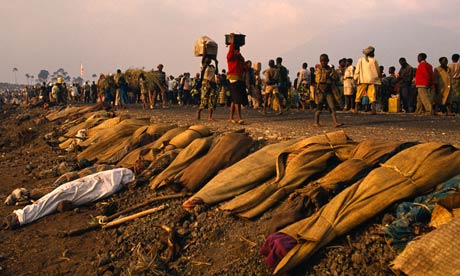 The terror I fled is still around. The deadline for the cessation clause of the refugee status for Rwandans who fled their country between 1959 and 1998 is getting closer: June 30th, 2013. If I cannot return yet, it is not my fault.
 ABC News writes that, "some [Rwandan] refugees are taking precautionary measures such as avoiding their beds at night." I don't really go to sleep these days," said Ephraim Rutabingwa, a Hutu refugee [living in the Nakivale camp in Uganda.]"
In the Democratic Republic of Congo, their youth has been spent in the forests. They are between 100, 000 and 150,000 human beings that the world has continued and persists to ignore. They survive living in the two Kivu provinces. If it hadn't been by the protection provided by FDLR, they would've been completely exterminated as their existence is deliberately obscured. Genocide against their Hutu community in the Great Lakes region which started on October 1st, 1990 is ongoing.
In 1994, the majority of them were only 10 years old or even less. Others were born after in the bush. But they are today men, women, and children living in inhuman conditions; however despite that, what their experience has taught them is that Rwanda led by President Paul Kagame is not yet safe. For their survival against his direct and commissioned attacks by local militias, they have to be constantly alert to defend themselves. They are survivors of the genocide that the Rwandan President and his funded local forces in the Kivus have committed and continue to perpetuate against them.
As the deadline of the announced cessation clause looms, two important international conferences on the subject were held in Belgium and South Africa respectively from 19 to 20/4/13 and 18/4/13.
The first meeting brought together a range of Rwandan political organizations and those from the civil society particularly operating outside the country and interested in the protection of refugees.
The second meeting involved eleven African countries and UNHCR Africa Regional Office: Burundi, the Democratic Republic of the Congo, Kenya, Malawi, Mozambique, the Republic of the Congo, Rwanda, South Africa, Uganda, Zambia, and Zimbabwe, all concerned with the problem posed by Rwandan refugees.
In the address of the South African Home Affairs Minister, Naledi Pandor, during UNHCR meeting on the Implementation of the Comprehensive Durable Solutions Strategy, explained that,
"The position of the UNHCR in relation to Rwanda has created anguish and uncertainty among the refugee community in South Africa. As such it appears as though much work requires to be done on the part of the UNHCR to clearly articulate the reasons for the cessation declaration among the affected refugee community. Much work requires to be done and the looming date for cessation, 30 June 2013, merely serves to add to the general anxiety among the affected communities. One pertinent question that has arisen with my own interaction with representatives of the Rwandan Refugee community is the declaration of cessation is not to be applied to Rwandans who fled the country after 1998. This they point out is a tacit admission that there exist conditions in Rwanda that would force people to seek asylum."
With cessation of refugee status – the issue that attracted most debate – it became clear during the meeting that not all states were ready to invoke a general application of the cessation clauses by 30 June 2013 in line with the strategy recommendation. Others underscored that for various legal, access, logistical, practical or other considerations, they are not in a position to apply the cessation clauses by the end of June, or will in any case not do so. Others specified that for the time being they will concentrate on taking forward other components of the strategy, namely voluntary repatriation and local integration.
Whether in those cases in which one or more States move ahead with the invocation of the cessation clauses or continue to consider applying them, it is clear that this will be done on a "case by case" basis or by "differentiated" approach.
Professor Charles Kambanda considers the Rwandan refugee issue as being wrongly addressed.
"The whole move is misguided. Kagame knows so well the reasons why people go into exile. He knows that the factors that led his parents into exile are a reality in Rwanda under his leadership. … refugees, especially refugees in refugee camps are a "ready-made" source of man power for a military attack on his dictatorship – the same way he used Tutsi refugee camps for his military victory- his major concern is to demolish all Hutu refugee camps in different countries. Kagame counts on use of force and violence than institutionalizing values. …his approach is not sustainable."
The cessation clause appears to pursue genocide against Hutus. The latter is implemented by the Rwandan government of President Paul Kagame and translated through several national policies: dispossession of property, discriminating practices in education, judiciary, health, and farming and employment sectors, and denial of political space. After 23 years of a combination of brutal and gradual extermination practices of the Hutu community both in Rwanda and the region, the question arises of knowing how strong are its members' willingness and resilience to resist their extinction as a distinct and vibrant social and cultural entity for the good of future generations.
Comments
Post a Comment