Upcoming Rwandan genocide: holes being dug as in 1993/94
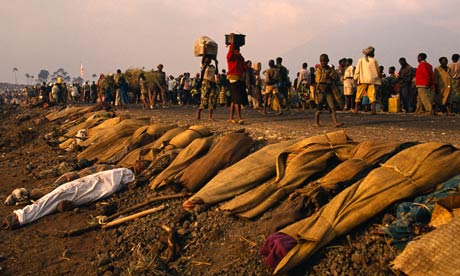
Some of the victims of hatred planted by Tutsi extremists in the Rwandan society for their insatiable hunger of political power.
Kigali, the Rwandan capital, does not have a sewage system. As a consequence, each house has to dig in the ground a deep hole and cover it to receive the human wastes of the household. That was the common understanding for every Rwandan about such holes. However, during the 90/94 civil war, an intensive digging of holes [potential mass graves] appeared in Kigali, even in compounds where they existed already and had been built in the usual process of developing properties, and did not demand some repair.
Many did not question that unusual digging of holes at the time. It is only after the tragedy that, people while recalling what had happened made the necessary connection. A week ago, a source in Rwanda reported that the phenomenon of digging holes in private properties had again reappeared in certain parts of the country. With more than 200,000 military and other security forces at the service of the regime, anyone can imagine how effective the upcoming genocide will be.
For concerned observers of the Rwandan political scene, they can see clearly that the conditions to enable the unfolding of such tragedy are gradually coming into place. The ongoing building-up of political tensions among Rwandans of which acceleration can be traced back to the speech of the Rwandan president in front of the country's youth on June 30th, 2013, calls for some readiness from national and international communities to face difficult times in a probable near future.
It was former prosecutor Gerard Gahima who asked last year how the international community was preparing itself for the next genocide in Rwanda, though many among Rwandans find that such tragedy started on October 1st, 1990, it has never ended but only taken different other forms devised by its master-minders.
In the mid-90s I came across a report which had been ordered by former US Secretary of State, Henry Kissinger. The focus of the study that had been ordered by his department was to analyse the repercussions of population growth in third world countries on US national security.
The resounding conclusions of the study were that effectively the rapidly increasing populations in developing countries constituted a serious danger for US. Among the recommendations of the report was the request that the US government had to take all necessary measures to address that threat.
As I look back to the 90/94 Rwandan civil war, with reference to above report and the diverse alliances that made RPF victorious, I am of the view that the threat highlighted by the then US government was significantly addressed in the Rwandan tragedy.
In 1994 the Rwandan Patriotic Front [RPF] had thousands of infiltrated agents and collaborators inside the country. Among them was one of my neighbours. He had dug a big and deep hole in his compound which as I reflect back was meant to become the grave for many victims of the tragedy. History will never account for all Rwandans, Tutsi, Hutu and Twa who indistinctively have been buried alive or dead in those mass graves.
Today RPF, which this year is coming out with a big bang to remember the 94 genocide 20 years after, has been implementing US policies in Rwanda and the whole region. This has been one of its consistent preoccupations thus even explaining why it has become untouchable because of its special ties with the American government.
The same way the slaughtering [or reduction of the number – sound more civilized] of Rwandans has been part of US foreign policy in the past – this being explained by the covering up of RPF authorities responsible of the mentioned crimes, there seems to be a willingness to let today RPF continue unhindered what it started since 1990. The reason is that, among other things, it falls exactly in line with their policies of reducing populations from developing countries.
If one looks at the issue pointed at by the referred to report and how it has been addressed particularly in the Great Lakes region, they can objectively conclude that Museveni of Uganda and Kagame of Rwanda have all along been the ground's officers charged of implementing that particular recommendation.
Besides every other techniques used in killing innocent civilians, I can today recall what I personally witnessed, but which at the time could not have meant in my mind anything to do with that policy of reducing the number of African populations.
Comments
Post a Comment